Quiz #1 - Answer
Quiz #1 - Answer
 I apologize for this first quiz as it may have been a bit too much of an in depth dive into the wording of the rules and definitions.
The answer to this quiz requires reading the exact wording of the relevant rules and definitions quite carefully. Let's look for the answer by process of elimination. The set of possible rules that apply are: Rule 10,11,12,13,14 (Right of Way rules, plus Limitation Rule 14). I'll go through each of them to decide which ones to eliminate and which might apply:
- Rule 13 (While Tacking):
- Neither of the boats are tacking (if they were, I would say so, or the diagram would make that obvious).
- So, Rule 13 does not apply and that leaves Rules 10,11,12 and 14 as possibilities
- Rule 10 (On Opposite Tacks):
- Are they on opposite tacks? You can look to the definition of tack. That definition says that their "tack" is their windward side.
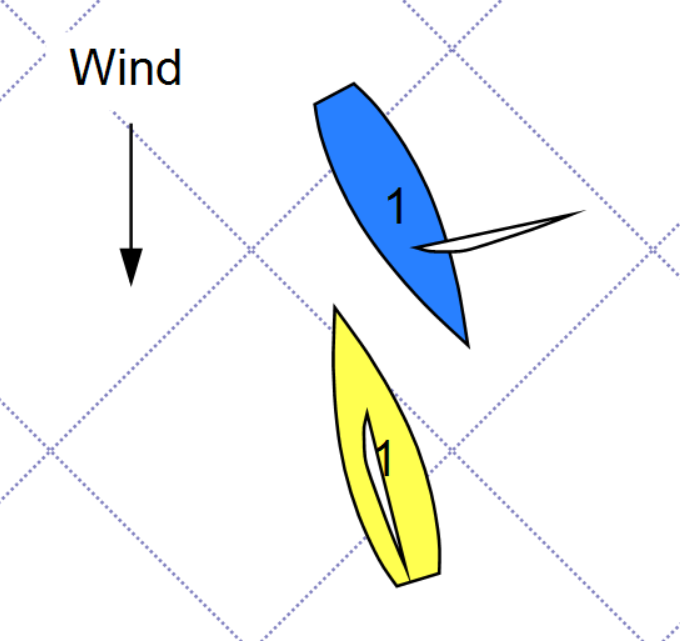
- The definition of Leeward and Windward clarifies which side of the boats is the windward side. This definition deals with a boat that is "sailing by the lee" (Blue), by using the side opposite to the boom to make this determination (and NOT the side of the boat the wind is coming over first). So, they both have starboard as their windward side and thus they are on the same tack.
- So, Rule 10 does not apply and that leaves Rules 11,12 and 14 as possibilities
- Rule 12 (On the Same Tack, Not Overlapped):
- Ok, we've determined they are on the same tack (starboard), but we need to determine if they are overlapped to decide if Rule 12 does or doesn't apply.
- The definition of overlap refers to the definition of Clear Astern and Clear Ahead; Overlap. This definition states that if "neither boat is clear astern" they are overlapped.
- Looking at the diagram you will see that neither boat is behind (clear astern) the other, so they are overlapped.
- So, Rule 12 does not apply and that leaves Rules 11 and 14 as possibilities
- Rule 11 (On the Same Tack, Overlapped):
- Rule 11 is short: "When boats are on the same tack and overlapped, a windward boat shall keep clear of a leeward boat."
- So, we've determined they are overlapped, and on the same tack. That leaves the directive: "a windward boat shall keep clear of a leeward boat".
- So let's try to figure out which boat is the windward boat and we should have the answer ..... right .... right?
- The definition of Leeward and Windward tells us: "the boat on the leeward side of the other is the leeward boat. The other is the windward boat"
- Uh oh ... You intuition my tell you otherwise, but looking at the diagram, it appears NEITHER boat has a boat on their leeward side. That also means that neither boat is the windward boat. So, while it "looks" like they are to windward of each other, they are not given the way the definitions are worded.
- So NEITHER boat is the windward boat, and the part of the rules that states: "a windward boat shall keep clear of a leeward boat" doesn't apply to either boat.
- Therefore while Rule 11 DOES apply, it DOES NOT actually help us. So that leaves Rules 14 !
- Rule 14 (Avoiding Contact):
- Rule 14 is not a "Right of Way" (Section A) rule, but a Section B (General Limitations) rule, but it is still of some help in this situation.
- Fortunatly, Rule 14 does not have any qualifications with respect to which tack a boat is on, or whether it is windward or leeward, or overlapped.
- The result is that Rule 14 always applies.
- The last paragraph of Rule 14, which refers to the "right-of-way" boat, does not apply in this situation,
- but part (a), (b) and (c) do apply with "a boat shall avoid contact with another boat" being the operative statement.
- It would be reasonably possible for both boats to be able to take action to avoid a collision, so Rule 14 requies them BOTH to do so.
- In the end, NO Right of Way rule applies and only Rule 14 applies.
In Summary:
- Neither boat MUST keep clear of the other
- But both boats must avoid contact
- If this scenario resulted in contact and a protest, then a jury would expect to see BOTH boats having taken some action to avoid the contact. The boat that did nothing or did the least to avoid contact would be the one likely to be penalized.
There are not many scenarios where no "Right of Way" rules apply.
Further Notes: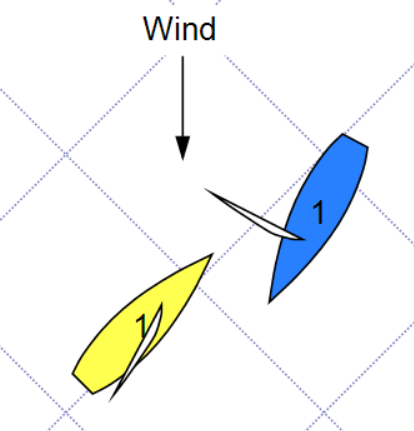
- You could draw this scenario where the relative positions are the same, but having both on the opposite tack (port). The result would be the same.
- But, If you kept the drawing the same but "swapped" sides so they were each on the others leeward side (see image at right), then you would get an equally strange result where:
- BOTH boats are the windward boat, and therefore,
- BOTH boats would need to keep clear of the other. And with that, the moment each boat avoids a collision, then the other boat is not keeping clear and both both would break Rule 11.
- Again, if there was a collision, and a protest, then a jury might:
- Exonerate both for breaking Rule 14 because they are BOTH right-of-way boats (Rule 43.1(c))
- Both boats might have broken Rule 11, so .... disqualify both? would they be exonerated?