Quiz #2 - Scenarios
 Published: April 1, 2026
Discussion - Luffing before the Start
It is certainly common for boats to protect their position at or when approaching the starting line to start. Leeward boats may want to luff windward boats to "close the door" or force the windward boat to be "over early". This article will discuss a number of common scenarios that arise at the starting line and how to determine what is and isn't allowed.
While other rules will be involved, the primary rule and definition we need to be aware of are:
- Definition: Proper Course - "A course a boat would choose in order to sail the course as quickly as possible in the absence of the other boats referred to in the rule using the term. A boat has no proper course before her starting signal."
- Rule 17: On the Same Tack; Proper Course - "If a boat clear astern becomes overlapped within two of her hull lengths to leeward of a boat on the same tack, she shall not sail above her proper course while they remain on the same tack and overlapped within that distance, unless in doing so she promptly sails astern of the other boat. "
Regarding the definition of proper course, there are two key elements to keep in mind:
- "A boat has no proper course before her starting signal" - This effectively means that while Rule 17 may apply, it actually imposes NO limitation at all before the starting signal.
- The other clause that is important is: "in the absence of the other boats referred to in the rule" - This means that a boats proper course may be very much influenced by things other than just a reasonable course to make the boat go fast. Other boats, race committee boats, obstructions, can all affect what a boats proper course is.
Regarding Rule 17, the clause to keep in mind is:
- "If a boat clear astern becomes overlapped within two of her hull lengths to leeward of a boat ... " which tells you when Rule 17 applies
- A point of practicality ... remembering or even noticing how the overlap was established can be a challenge at a busy start or mark rounding, but it is important for determining whether Rule 17 actually applies.
Take a look at the two scenarios below.
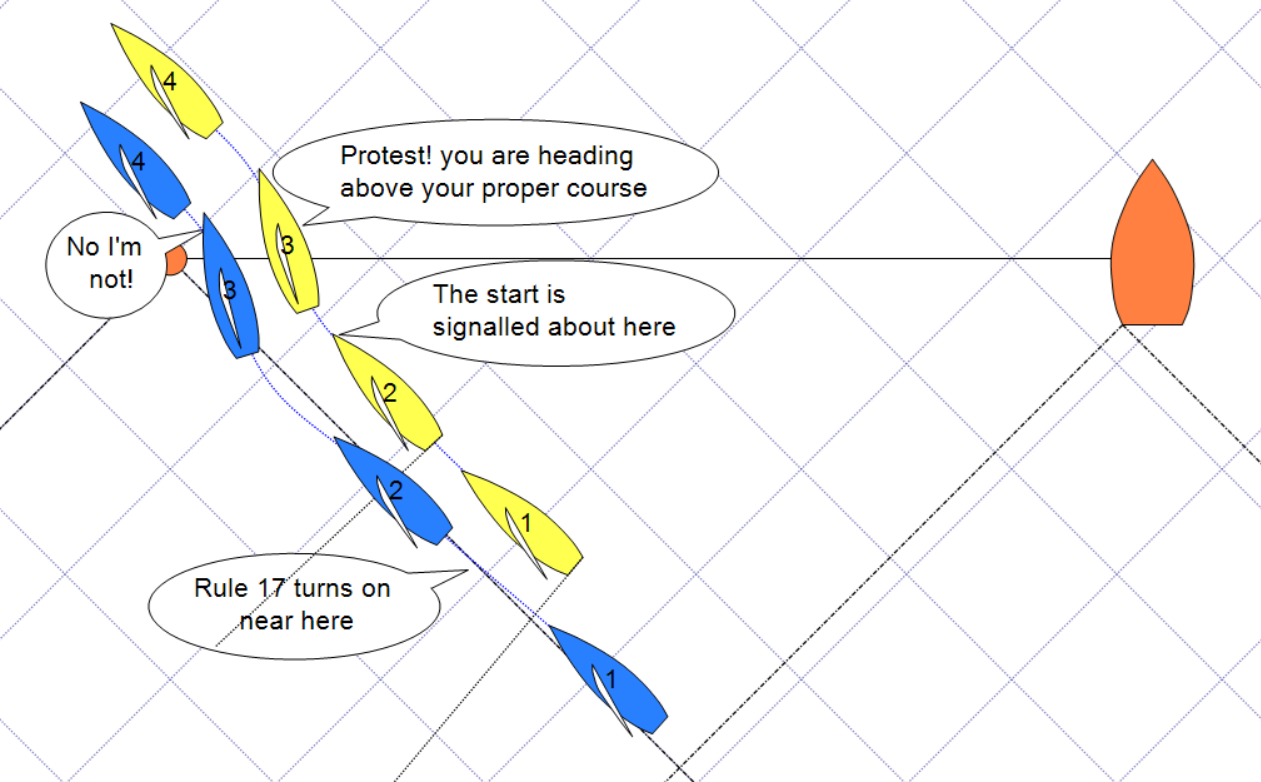
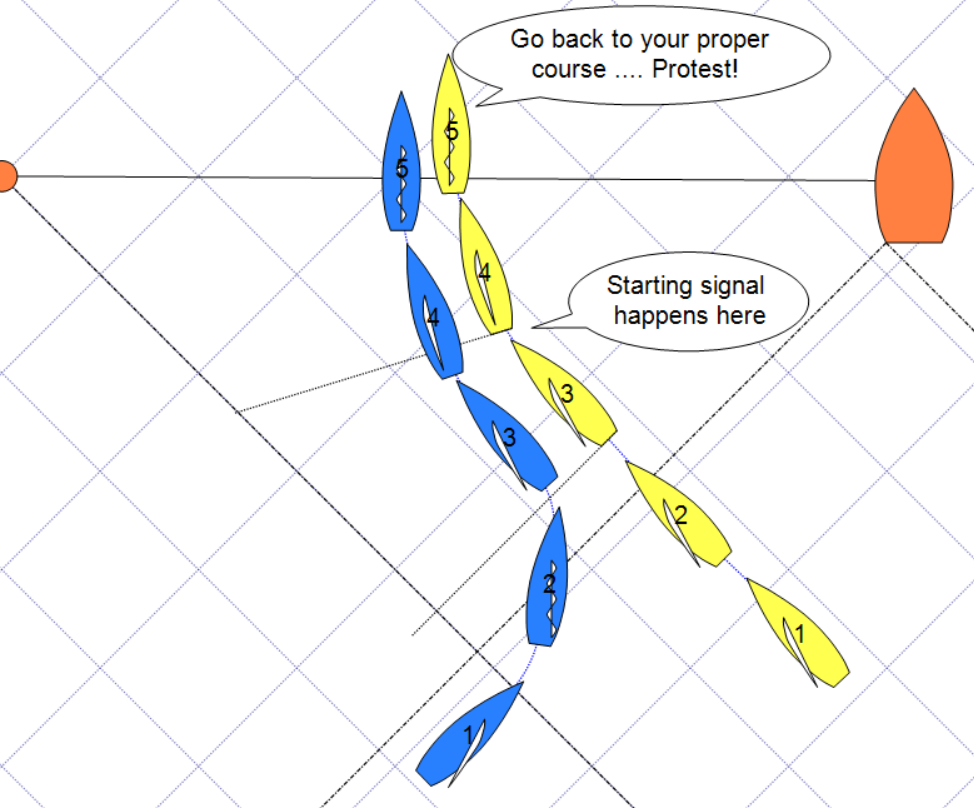
- Both scenarios involve the Blue boat luffing the Yellow boat near the starting line
- The difference to pay attention to is when the starting signal happens
Scenario #1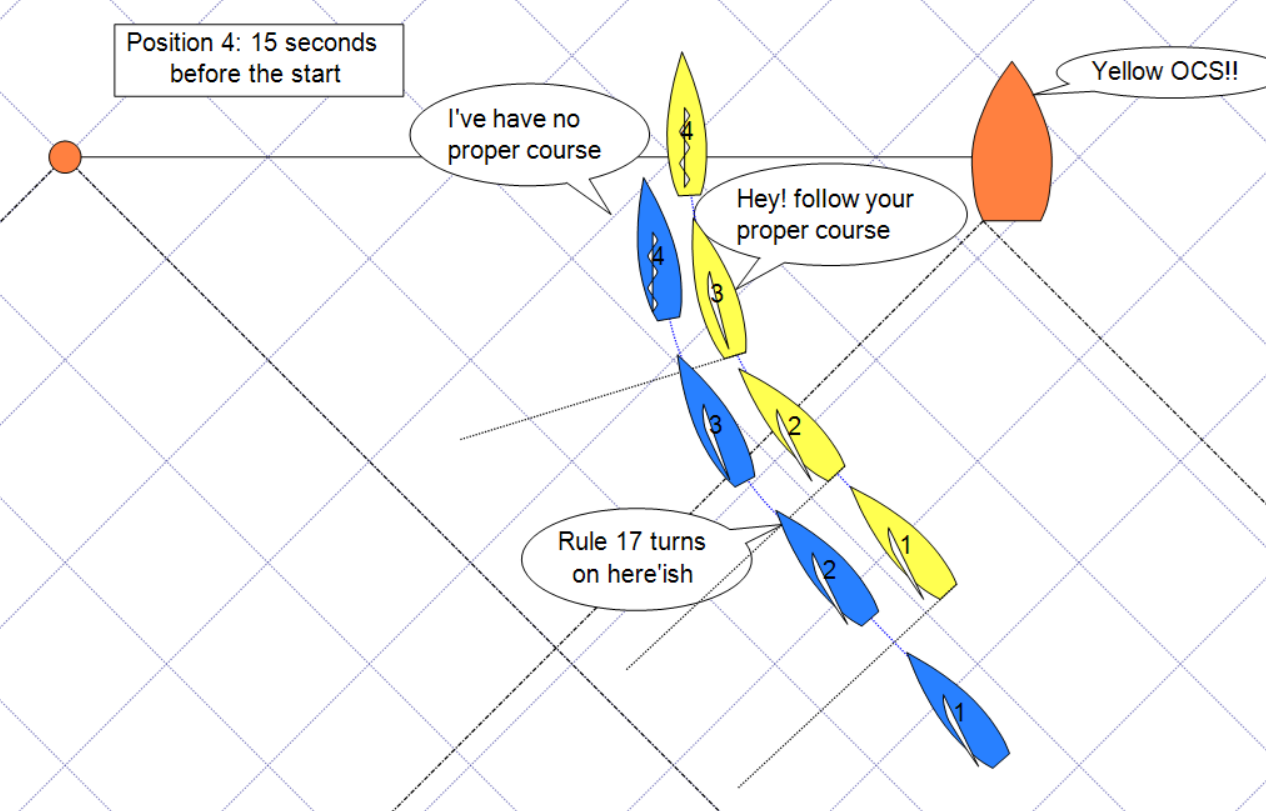
- Position 1:
- Blue has not yet established an overlap
- Rule 12 (On the same tack, not overlapped) applies and Blue must keep clear.
- Postion 2:
- Blue has just established an overlap from within 2 boat lengths to leeward
- Rule 12 stops, and Rule 11 (On the same tack, overlapped) begins and Yellow must keep clear.
- Rule 17 applies, but because the starting signal has not gone, there is no actual limitation.
- Postion 3:
- Blue is still overlapped and is luffing slowly, and does not break Rule 16.1 (Altering Course)
- Yellow is also luffing up to keep clear (barely), so doesn't break Rule 11
- Blue IS sailing above her proper course but is allow because it is before the start.
- Position 4:
- Blue has forced Yellow across the line and to be OCS
- Yellow is complaining that Rule 17 applies to Blue and that Blue should return to close hauled
- But because the starting signal has NOT gone yet, Blue is allowed to sail up to close hauled and is NOT require to sail her proper course (or below)
- Result:
- Blue broke no rules. Yellow is OCS
Scenario #2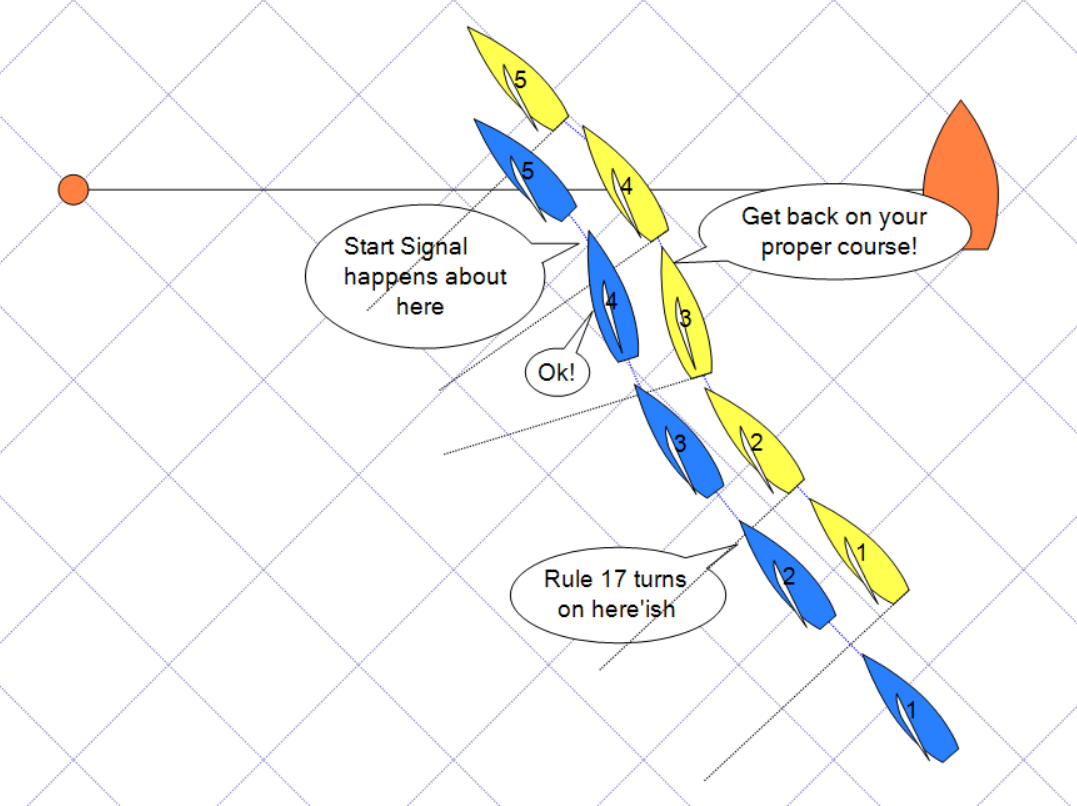
- Position 1: (same as above)
- Blue has not yet established an overlap
- Rule 12 (On the same tack, not overlapped) applies and Blue must keep clear.
- Postion 2: (same as above)
- Blue has just established an overlap from within 2 boat lengths to leeward
- Rule 12 stops, and Rule 11 (On the same tack, overlapped) begins and Yellow must keep clear.
- Rule 17 applies, but because the starting signal has not gone, there is no actual limitation.
- Postion 3: (same as above)
- Blue is still overlapped and is luffing slowly, and does not break Rule 16.1 (Altering Course)
- Yellow is also luffing up to keep clear (barely), so doesn't break Rule 11
- Yellow is complaining that Rule 17 applies to Blue and that Blue should return to close hauled
- Position 4:
- The starting signal goes off!
- Blue has forced Yellow across the line and to be OCS
- Blue immediately starts returning to her proper course, which is close hauled
- Position 5:
- Blue has returned to her proper course
- Yellow has followed, but is still OCS would be scored as such if she continues to sail the course.
- Result:
- Again, Blue broken no rules because she returned to her proper course at the signal. Yellow is OCS
In both of these scenarios, other than Yellow being OCS, Blue broke no rules. Now take a look a the following more challenging examples and take the Quiz to try your hand at
I'll go over the Quiz results and explain the answer next week!
Quiz Scenario #3
 Here is a scenario where Blue tacks into a right-of-way position and luffs Yellow up across the starting line. Blue's luff continues after the starting signal. Yellow is scored OCS and Blue.
- Should one of them be disqualified?
- Under which Rule?
- Rule 17
- Rule 11
Take the Quiz #2 below to answer. I'll explain the answer in the next discussion in a week or so.
Quiz Scenario #4
In this scenario Blue established an overlap on Yellow from clear astern. The starting signal goes BEFORE they reach the line/pin. Blue luffs Yellow above close hauled to get around the pin. Yellow also luffs up, but complains and protests.
- Should one of them be disqualified?
- Under which Rule?
- Rule 17
- Rule 11
Take the Quiz #2 below to answer. I'll explain the answer in the next discussion in a week or so.